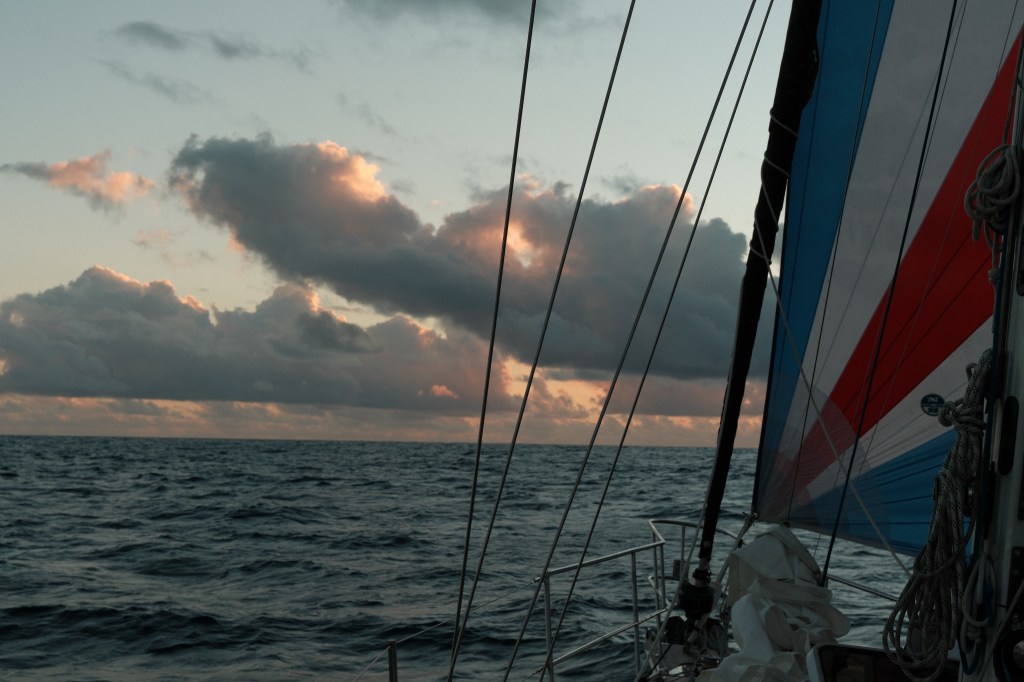
Oh to sail across an ocean with little experience and even less hardiness of the constitution – or is it the other way around?
We completed our Pacific crossing a little over a month ago, and already I could not recount a chronological telling of our passage if I tried – the days blended together and were not demarked by the passage of time – they were demarked by the change in wind, the shift in swell, the pace of the boat. Time really held little relevance. The order of events even less. We had a distance to travel of 3,000 nautical miles, at a pace so slow – 5 knots – if you thought much about it, it didn’t seem like it would ever get you there.
But I will never forget what it felt like to be on such a trip. There was no exit, you could not quit. The only certainty was no matter what was going to happen, the only option was to continue through to the end, and the only resources available to us the bits and bobs we’d brought along.
Aboard were Jesse and myself, who knew enough to know what we were afraid of, and my brother and his wife, who had flown in with no sailing experience but enough faith in us to volunteer for this adventure. I can tell you, it’s the greatest vote of confidence when two people, especially one being your older brother, ask to ride along on a potentially life threatening journey of which they hold little knowledge and will be reliant on your preparations and skills to make it to the other side. I did not know my big brother considered me a truly competent person until he boarded the boat and we threw off the dock lines. Whether he still does after all is said and done, well, that is not for me to know.
The following series of posts covers our 24 day passage from Cabo, Mexico (or La Paz, Mexico?) to Nuku Hiva in the Marquesas islands of French Polynesia.
— The Beginning —
The journey started out as many do – a mad-dash to complete paperwork, stash provisions, and finish the last projects. Add to this the million other tasks you set forth for yourself under the guise (the very true and accurate guise) that it will be easier now at dock than in the open ocean or at anchor in some far flung remote sun baked resourceless atoll in the South Pacific. The list of tasks grows monstrous.
This would be our last access to a spigot with fresh water for six months. You cannot imagine the number of tasks I set forth in my mind to complete with the spigot as I lay awake at night in the days proceeding our departure.
When crossing the Pacific, you prepare for the worst. It is the largest ocean on the planet and the longest passage most boats will undertake in a circumnavigation. You prepare the boat for serious storms and even more serious breakdowns. You’re re-inspecting your rigging god-forbid you lose the mast. You’re going over the engine time and time again with your uneducated eyes, poking and prodding it, checking it’s fluids, examining for leaks, inventorying the spare parts. Do I have replacement gasket 129155-52050 for the spare fuel lift pump? Really in your mind, you’re hoping the whole thing doesn’t just explode mid ocean. Some internal chamber corroded from years of salt water cracking under the pressure, rendering the engine useless. You remind yourself it is an auxiliary engine.
But you hope for the best – You’re sailing from one favorable tradewind into another, with typically benign weather and favorable winds to fill the sails. One of the best sails on the planet! Stories of setting the sails and gliding through long period rollers for days on end without adjustment give you optimism. Some boats make it through the ITZC in 12 hours. A spectacular sail for 22 days!
Our journey landed somewhere between the worst we prepared for and the best we hoped for.
Weather was… uncooperative. Overall, across the full passage, we had extremely light winds. Our weather router, who does not tend to veer into dramatics, summarized our crossing timing as having had “VERY light conditions.”
We spent the first week fighting the wind angles to reach our waypoints – crew hand steering through the night to keep the sails full in light winds and rough swell. Eeeking out 4kts in the direction we wanted to go by sheer force of will. Trying every trick in the book with the sails we had to improve downwind performance – wing on wing, poled out genoa, asymmetrical spinnaker, asymmetrical spinnaker poled out. Desperate messages to our weather routers dressed up as every day inquires, “Any pointers on sailing these angles with light winds?”. Everyone was exhausted and sleep deprived.
A sail configuration and angle would start working, the boat would mercifully begin to make progress through the water, the dotted line on the plotter ticking off dashes along our intended course, and the crew would share a sigh of relief – deliverance at last from the jarring rocking and violent slapping of sails. An hour later the wind would shift and we’d be headed to Hawaii. No, now back to Mexico. On to Panama? Rarely it seemed was the wind blowing us to our intended destination.
We were not alone – the WhatsApp groups of the sailors crossing with us were filled with variations of the eternal question “Are we alone in this struggle?” The resounding response was the much craved “No, it’s happening to all of us.”
There were acrobatic dolphins, leaping higher than the bow and doing twists in the air. Endless giant schools of flying fish flitting across the surface of the ocean. The water the deepest, purest blue – the depth of jewel tone indescribable. The journey ahead of us impossibly long. We were living in our eternity.
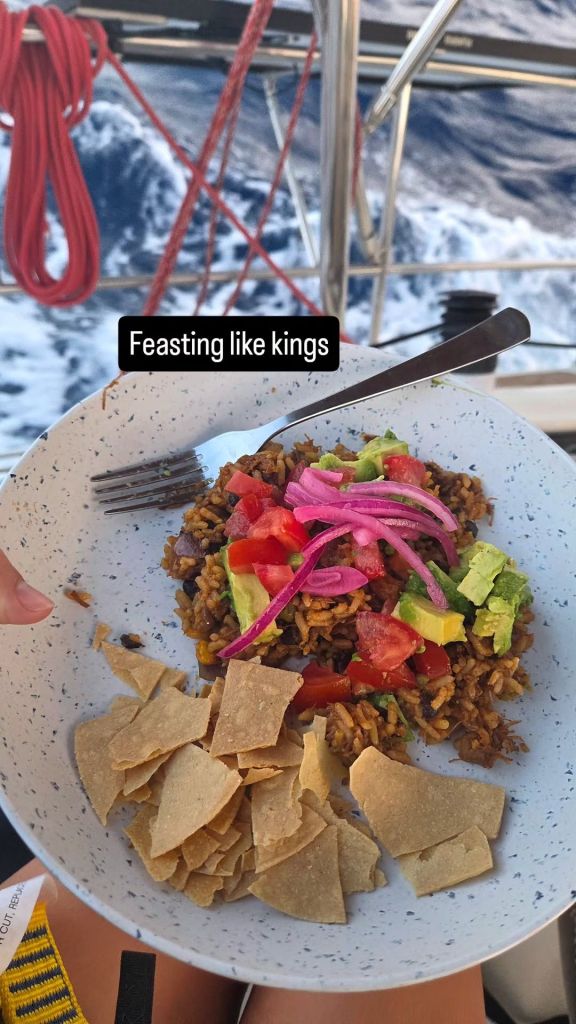
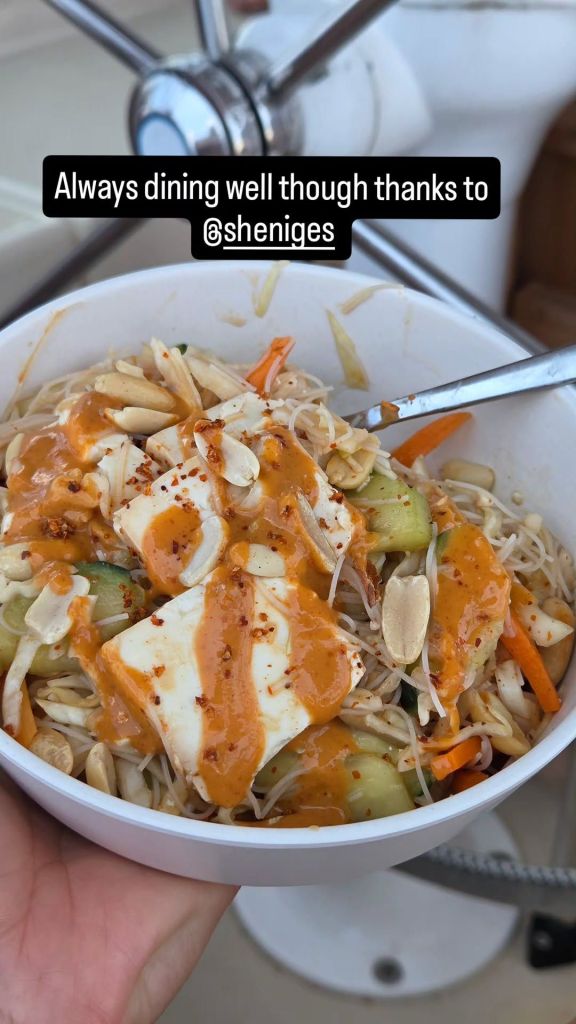
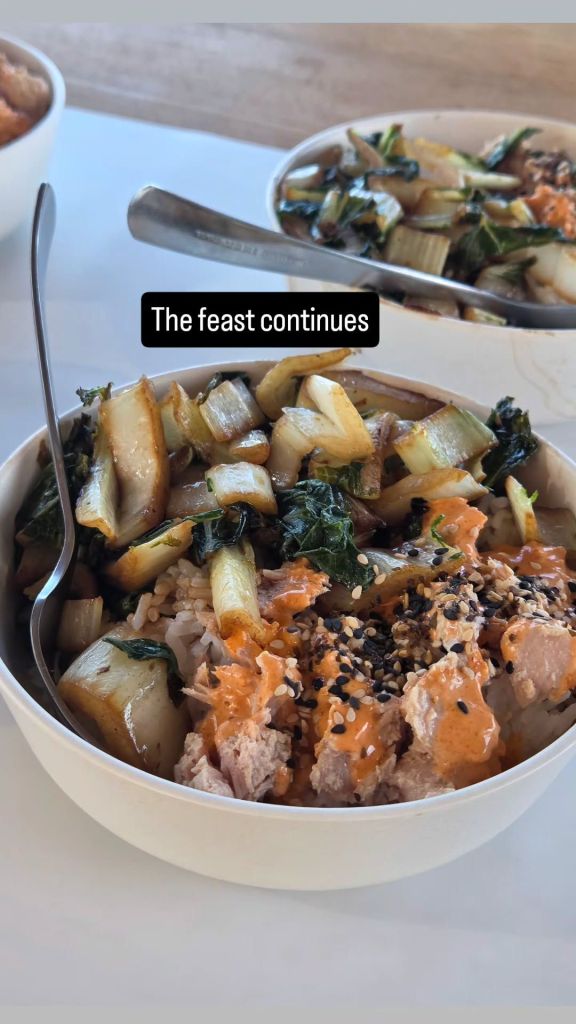
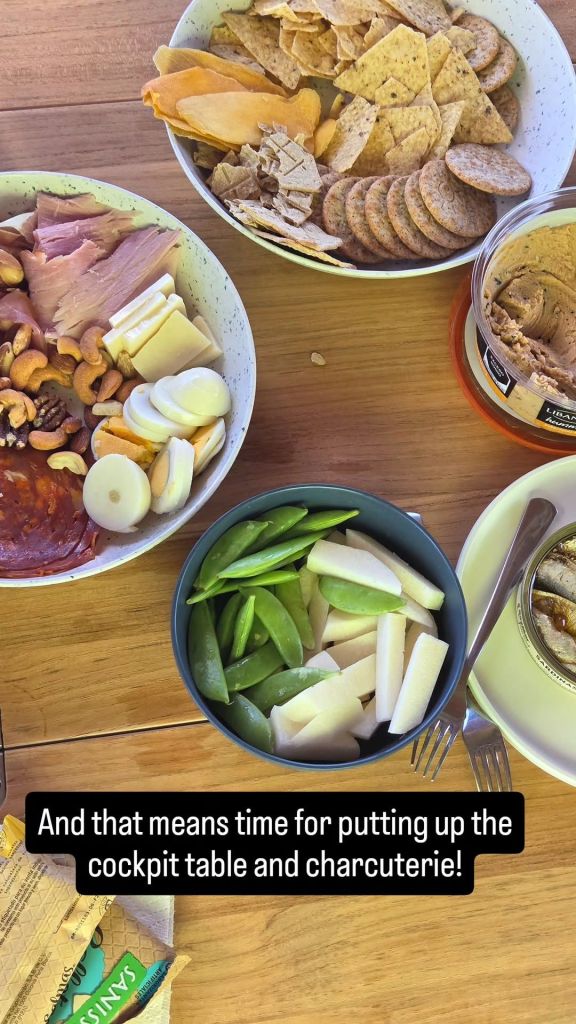
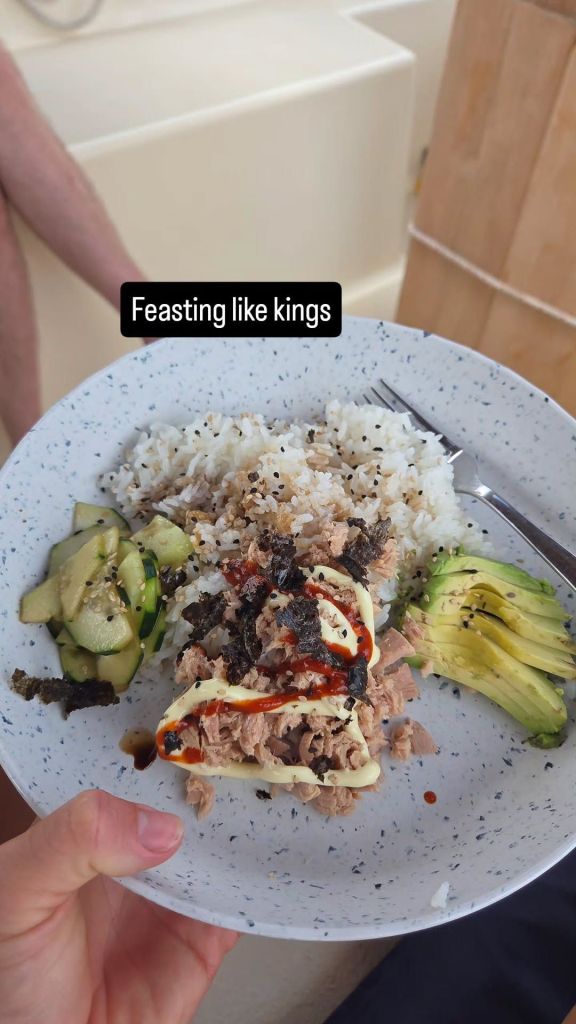
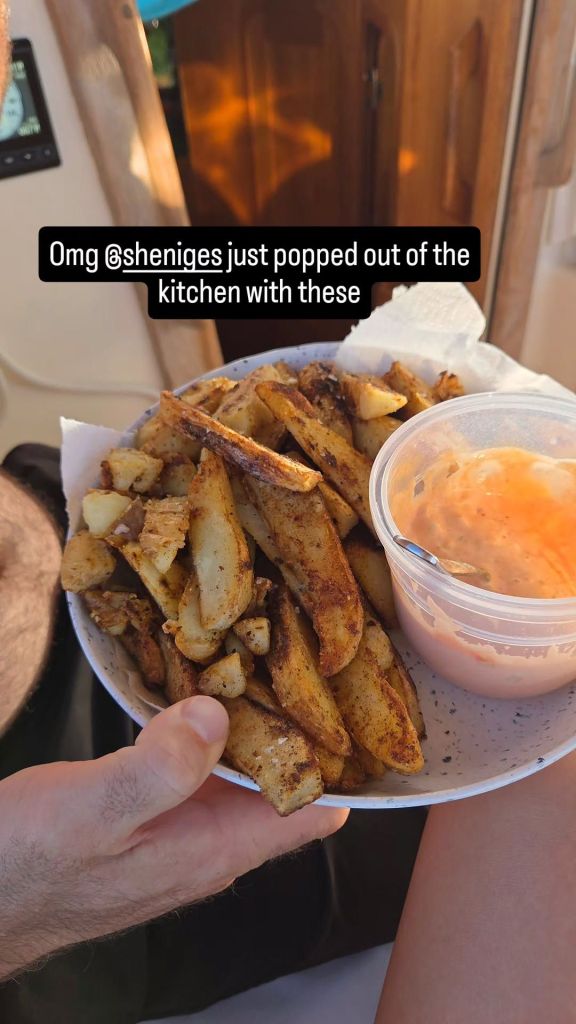
Our non-sailing crew, my brother and his wife, stared on with wide eyes. Not knowing much about sailing, I can only imagine what was going through their minds. They focused on what they knew – the galley – and delivered amazing meal after amazing meal as Jesse and I tangled with the sails above on deck. Peanut sauce tofu bowls. BBQ pork rice and beans. Toasted pecan apple crisp. Huevos rancheros with pickled onions. On a particularly difficult morning, the sight of fresh pancakes and cold sliced fresh fruit emerging from the galley nearly brought me to tears of joy. After a long day of sail changes, baking sun, and relentless rolling, the appearance of a large serving plate piled high with homemade jojos brought us back to life.
In this first stage of the trip, we had one beautiful evening of consistent enough wind to sail well and the swell lined up perfectly for us to surf down wave after wave. Dirk was spotting sea birds. Jesse was helping design a new strap for the kitchen stove so Sarah could lash herself in while we accelerated down waves. The crisp breeze was blowing through the cockpit as I surfed us down wave after wave, feeling the moment the swell would pick the boat up and adjusting to keep the bow forward. It is exhilarating to surf a 29 gross ton boat in the middle of the ocean as you make your way to a far flung paradise, your near and dear family packed on board with you. A motley crew on the adventure of a lifetime! It felt like we were flying. Like we were actually sailing across the Pacific. This only lasted one evening before the winds died down again, but it was a confirmation of why we’d set off on this absurd trip in the first place.


Leave a note in the logbook