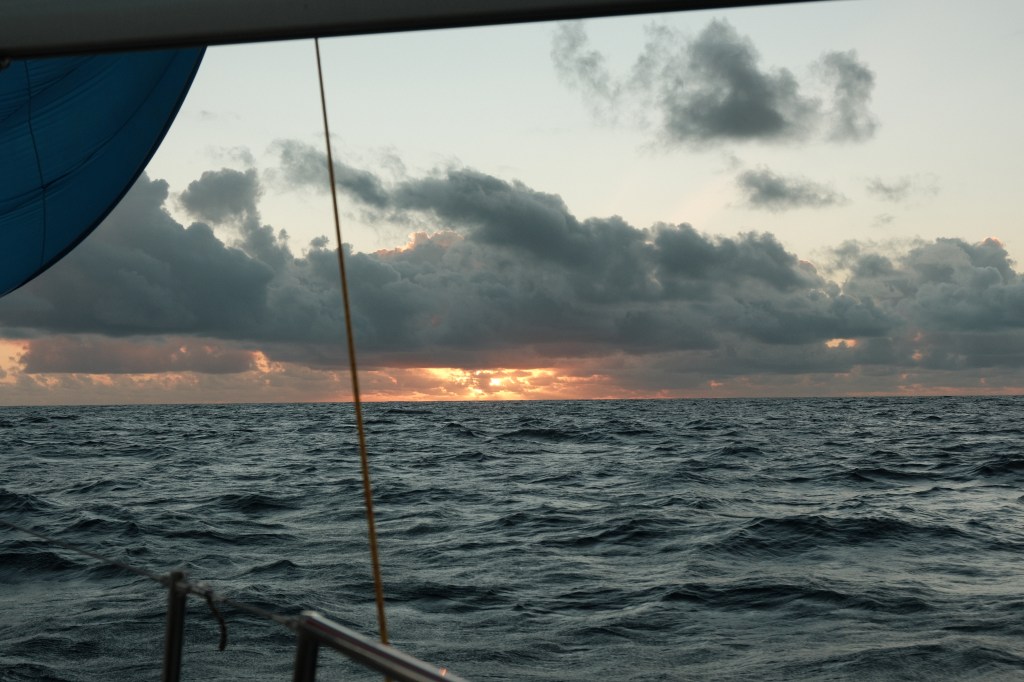
As we patiently awaited our arrival to the NE Tradewinds, where things would smooth out for us and we’d be able to set the pace for the remainder of the journey and settle into life at sea, a message from our weather router came through. “Watch out – you’re heading into major convective activity. Big red blob in front of you. Keep eyes on it. They move FAST.” We frantically pulled up the satellite weather. It appeared there would be no NE Tradewinds for us – it was straight into the ITCZ.
Eleven days later we emerged on the other side. The ITCZ had reached it’s tentacles up to 10 degrees North to greet us, and did not seem to fully release us until somewhere around 5 degrees South – nearly 1000 nautical miles of atmospheric nonsense – squalls, lighting storms, inconsistent winds, and expanses of dead air.
Our first squall quadrupled in size as it approached, going from a radar reading of 4nm away to opening up a faucet on top of us seconds later. The cockpit filled with fresh water, as did the galley, settee, heads, and berths through the open hatches and portholes. Jesse shivered from the icy rain. This first squall was the heaviest rain and highest wind speeds we saw the entire trip, clocking in at only 25kts.
When the second squall appeared on the radar, it was all hands on deck – every port hole and hatch was dogged, life jackets were strapped on, and sails were reefed. We all stood at attention in the cockpit ready to jump to action, watching the squall five miles off on the horizon. We waited. The helmsman watched the radar screen. The squall was not moving quickly. Thirty minutes later a light breeze passed over the fully furled genoa and triple reefed main. A few misty drops of rain collected on the deck.
And so our battle of the ITCZ began. It was not one of violent squalls and 50kt wind gusts ripping sails apart. It was a war against water intrusion into the interior of the boat while avoiding heat exhaustion. With temperatures in the high eighties, humidity so thick it was a wonder there was even oxygen in it for breathing, light to non-existent wind, and a sun so intense even a slice of it touching your skin burned instantly, keeping hatches and port holes open for ventilation was not an option, it was a necessity.
But with every squall we had to jump to action to close them – at first we closed everything – lurching forward from our positions of sweaty lounge to slam the portholes, twisting the locking knobs as quickly as our fingers could move. With the breeze cut off, the cabin turned into a sauna within seconds. Everyone emerged into the cockpit in various states of undress, desperate for fresh air. After so many light squalls with barely a hint of rain, our lurches to action slowed. We’d leave some openings partially open, a scrap of fresh air to breath. But the next squall would unleash a river that flowed up and under the vented hatches. The lurch to action had to be even faster. The stream of water from the cabin top was being funneled directly through the porthole into the pantry, onto your laptop – it had to be stopped as quickly as you could move.
And the rain was the predictable enemy. There was another enemy that surrounded us at all times, that was ever present, always there when one peered out a porthole or looked over the horizon. It would lash out without warning, delivering a devastating blow when it did – the ocean swell.
Watching ocean swell break over the boat when the hatches aren’t dogged is as beautiful as it is horrific. The green water, sparkling and turquoise as the sunlight passes through it, continues seamlessly from the ocean, to the deck, through the cabin top, and into the cabin. An uninterrupted arch, viewed from the cockpit, frozen in time. The port settee is saturated through. Soap bottles knocked off the counter are bobbing around the floor in the forward head. The sump pump goes off.
When the heat became its worst, when we were hosing ourselves off in the transom shower fully clothed, when the wet handkerchiefs draped on everyone’s neck began to let off the stench of days of absorbing sweat and never dying, when the galley stopped turning out hot meals and instead parceled out pieces of frozen fruit and cold tofu bowls, a message came in from our weather router: “Wind will fully die as you approach the equator – hope you packed oxygen masks.”
This messages ranks high in the list of most devastating messages I’ve ever received. It getting hotter, more humid? How could we possibly stay cool? We had already played our best hand, all the stops had been pulled out, we didn’t have anymore tricks up our sleeves. We would survive, but would we come out the other side the same? Would this impending suffering change who we were? Alter our characters forever more?
Thankfully our weather router was wrong. The next day the humidity faltered in it’s oppression of us. The air became slightly more breathable. Our sweat ever so delicately evaporated from our skin if we sat still enough. Limiting exertions was critical.
The big exertion for the day (next to adjusting sails, of course) became crafting the sunshade collage – beach towels and curtains clipped, strapped, and velcroed across the bimini supports and stanchions. Patching the tiniest cracks of sunlight with kitchen towels, washcloths, handkerchiefs. We improved the design every day. Moving it from port to starboard, towel by towel, as the sun passed through the sky above us.
The crew decided I was the best at crafting the sunshade. They spoke of it as an art form, and me its master. Midday, when it was time to move the coverings to the opposite side of the cockpit, I would take the lead and announce they were witnessing Michelangelo painting the Sistine Chapel. They would provide supportive commentary – Look at how she straps the leading edge of that towel down to stretch the shade an extra two inches. See how creatively she employs the handkerchief to eliminate that slice of sunlight? In retrospect, it appears clear they were egging me on so I’d undergo the exertion of building the shade fort. But at the time, in my heat-induced delirium, I did not see through this obvious ploy.
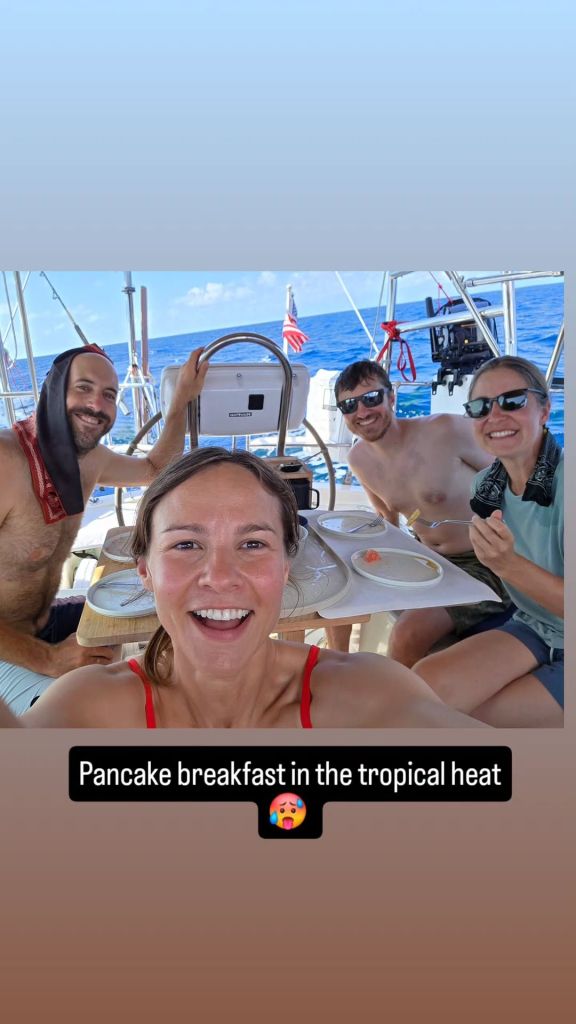
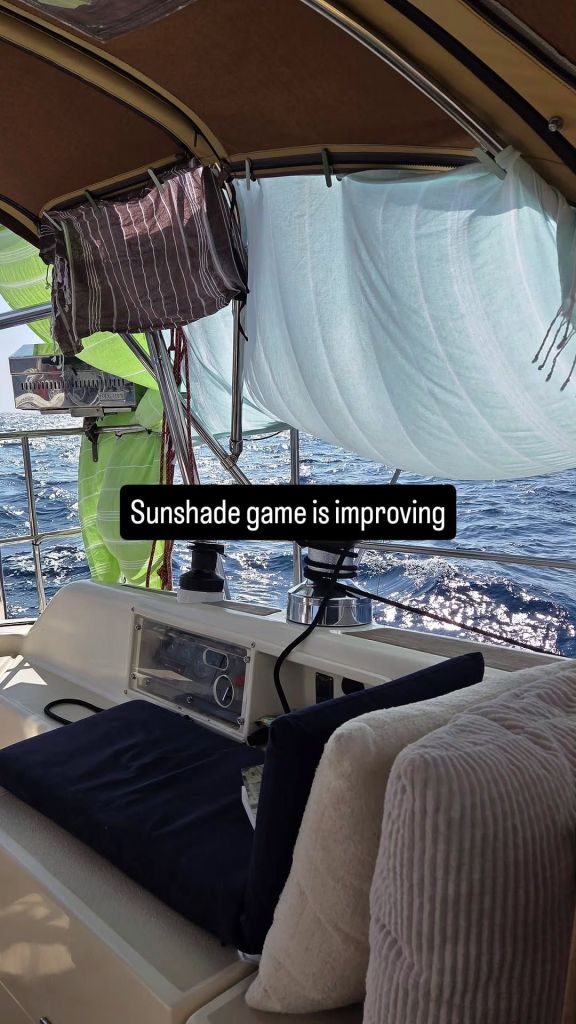
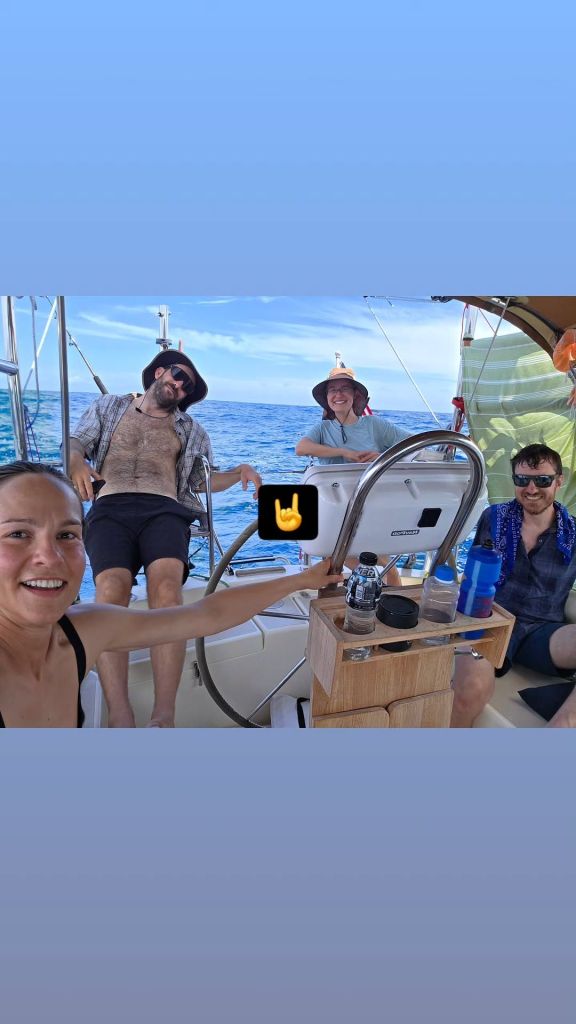
As we were negotiating what we thought would be the totality of the ITCZ, just starting to feel we were making meaningful progress towards the other side, we were treated to a rare meteorological phenomenon dubbed the “mirror” ITCZ. It is exactly what it sounds like – a second ITCZ below the normal one. A real-life Bowser’s underworld we were headed straight for. But there was nothing to be done except to continue eeking out what had become of our existence on this tiny sailboat in the middle of a giant ocean under the baking sun.
You gain an interesting sense of humor under such circumstances. The crew spent hours detailing the plot lines and story arc for an animated movie titled “Toy Story, A Toy’s Story,” an extension of the Toy Story franchise in which Woody and a full cast of new characters float off to the great garbage patch in the sea. The refilling of the dish soap pump during heavy swell while being tossed side to side became hilarious slapstick. A new crew member joined us, “Mr. Spoonman,” a piece of bamboo spatula handle Jesse sawed off and was using as a jury-rig for the whisker pole buttons which sheered off. Jesse drew a face on Mr. Spoonman and Dirk sang Soundgarden’s Spoonman to Mr. Spoonman when he was deployed. We named the two boobies that moved onto the boat Milly Booby Brown and Mittens and crafted an elaborate “from hate-to-love” romcom narrative for their relationship. We laughed a lot. It was really all we had left.
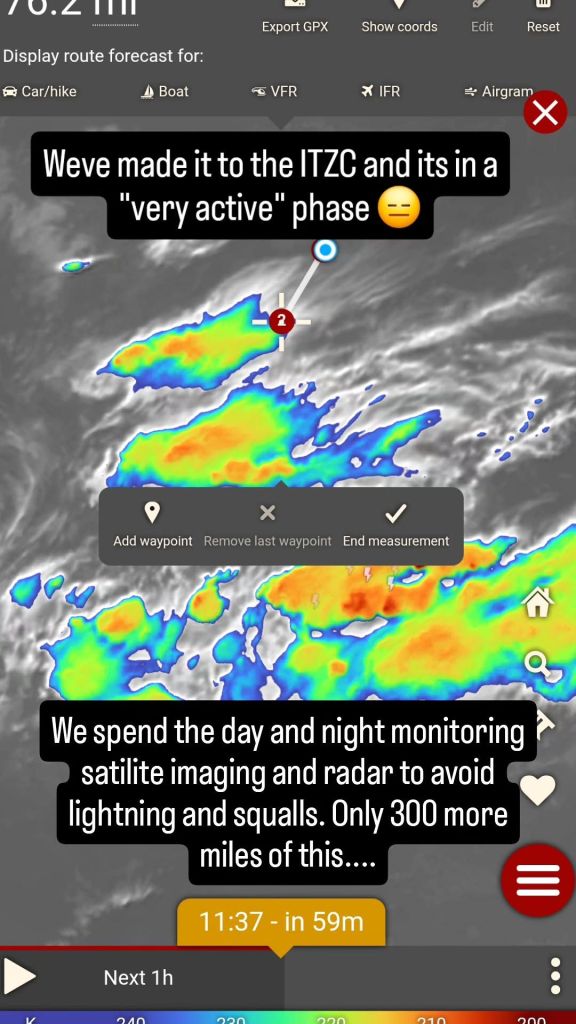
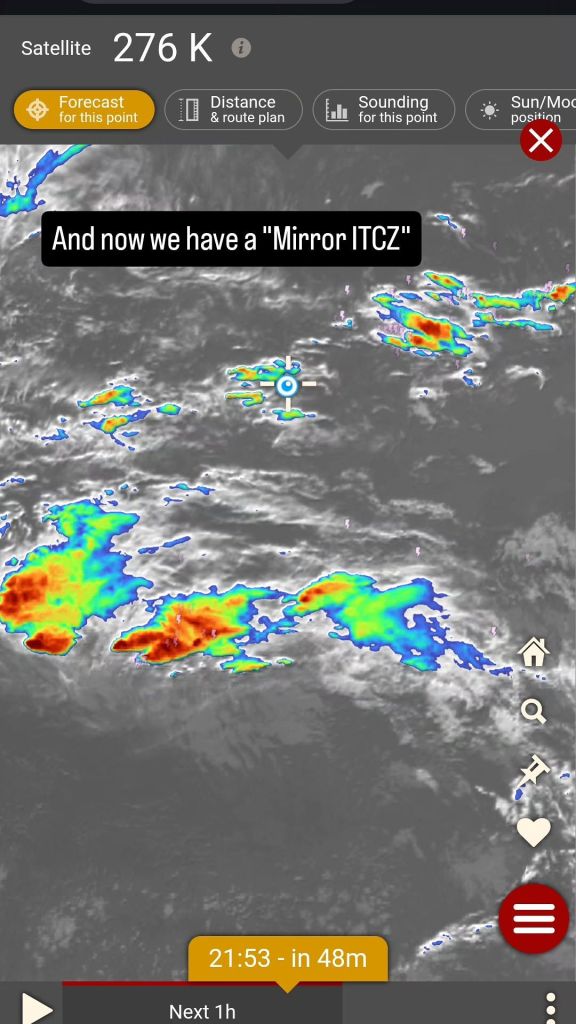
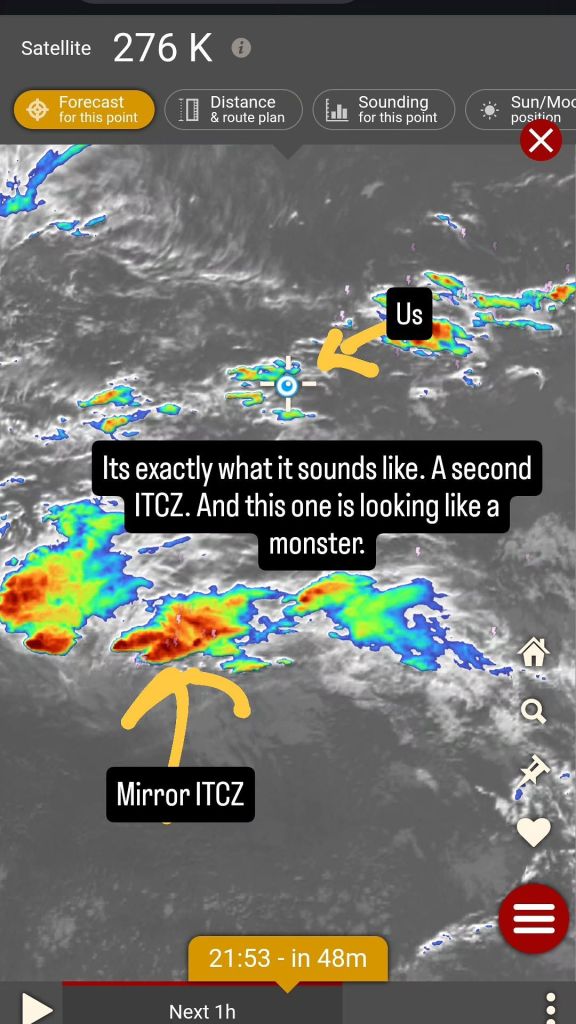
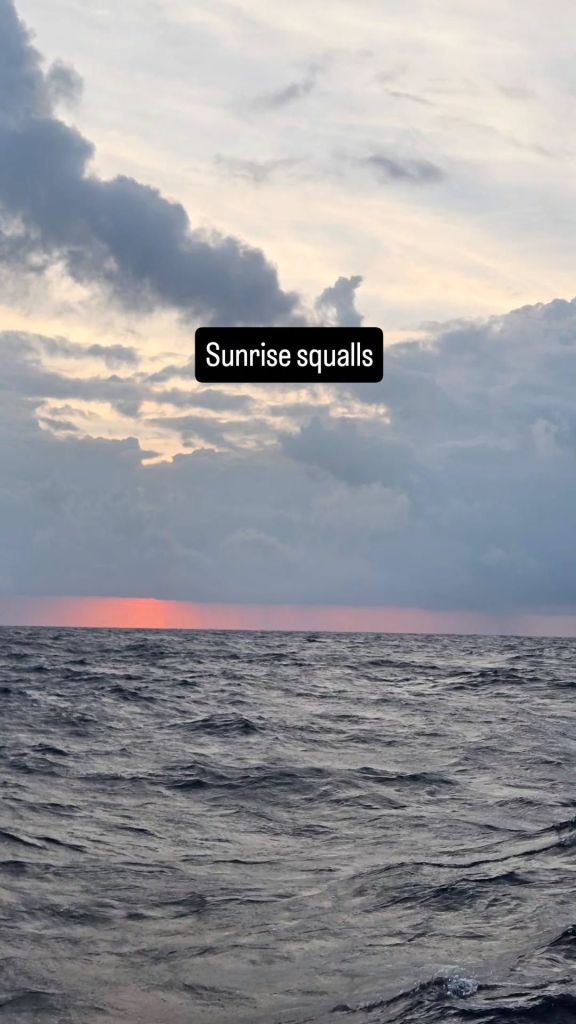
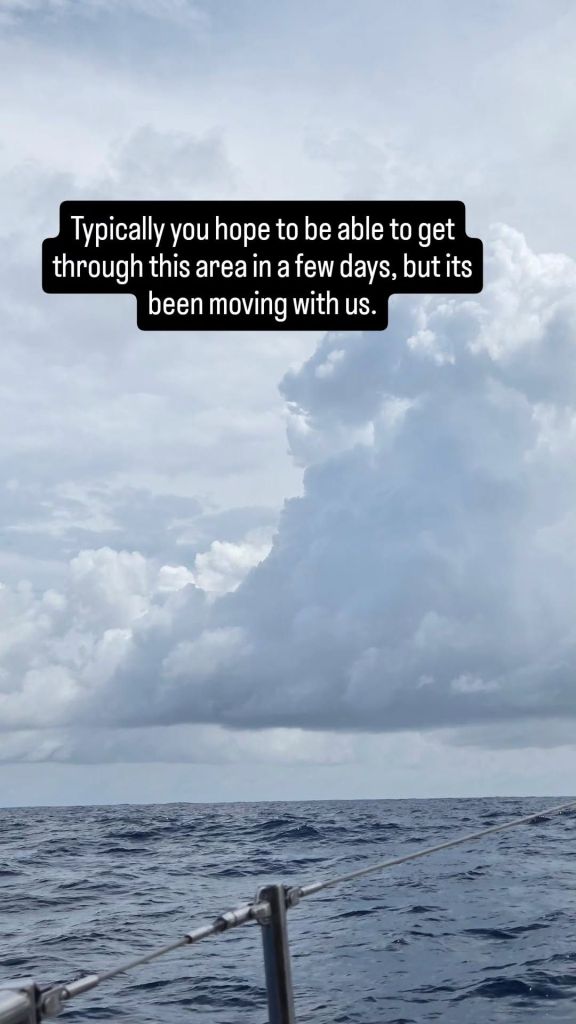
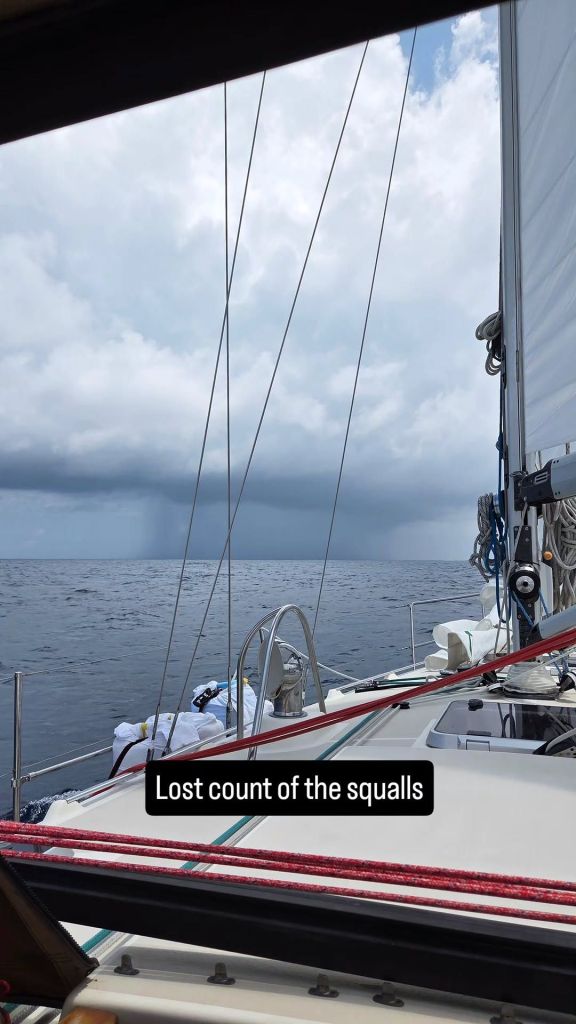
An enlightening set of my Instagram posts from under way. First post was April 10th as we’d been in the ITCZ for a bit and were not looking forward to the 300nms more of it we thought we had. Fast forward to April 14th for the second two posts, we’d made it through ~500nms of it and then the mirror ITCZ showed up which we were were just entering.


Leave a note in the logbook