Total Days at Sea: 24 depending on who you ask.
You may remember the odd uncertainly on where this particular Pacific crossing started from – was it Cabo, the tip of the Baja peninsula, or La Paz, tucked 150nms up around the backside of the peninsula in the Sea of Cortez? After everything that happened, I feel it was Cabo. There is not consensus within the crew on this matter.
We left La Paz on an incoming tide. Despite knowing we had 3000nms to go, it was emotionally difficult to kick off the first 3nms in such poor fashion, motoring into 2kts of current against us as we made our way out of the La Paz channel. The sun was out, the skies were blue with a few decorative clouds ready to catch the waning rays of sun as evening came on. The forecast called for little wind and the plan was to motor out of the Sea of Cortez and into the Pacific where we’d be able to set sail.
We ended up having wind right away, almost as soon as we cleared the La Paz channel. The current against us faded away, the sails were up, and now, emotionally speaking, we were setting off properly. This lasted for a few hours, but then the wave state picked up, the wind backed to be forward of the beam, and all of a sudden we were beating upwind into 25kts. A horrible turn of events for the emotions, and I now know, a common one for sailors heading to sea from La Paz. The local winds pick up and shift direction around the point, a not so lovely goodbye from Baja. These were the first rough seas Dirk and Sarah had ever experienced – I was keeping an eye on them as they sat quietly next to each other on the cockpit bench, I can only imagine they were wondering what the hell they had gotten themselves into.
The gusts continued to increase in frequency and strength. The slamming was getting worse and worse. The sun had set and we were in the pitch black now. Waves were smashing on the cabin top and sending spray into the cockpit. We decided to reef the genoa for a more comfortable ride. As we reefed, getting thrown up and down, slamming into the steep waves, the bilge alarm going off intermittently from the vertical acceleration, all of a sudden the furler line went slack. We shined our headlamps up to the bow while clutching onto the stanchions and winches to keep us in the boat, and could see the line had released from the furling drum. I swore. Many times and loudly. Jesse grabbed a spare line, fought his way to the bow, and lashed the remainder of the sail to itself around the forestay. He came back to the cockpit, turned the motor on, and without a word turned the boat back to Cabo.
And thus began The Return to Cabo, and episode of this crossing that was much referred to throughout the trip. The Return to Cabo is of mythic proportions. We’ve had bad sails before, but the combination of the terrible physical state of the sail with the emotional upheaval of having to turn around within the first 24 hours of crossing the Pacific, and adding on top having new crew on board who had never been in this type of sea state – each element exponentially magnified the experience into something much larger than life – and we were living it.
The boat was slamming into waves, spray coming up over the cabin top and smashing into the Bimini windows like a semi-truck passing you on the freeway. The boat went up and up, and then you were free falling for a moment, before a jarring slam, followed by the punishing sea spray into the cockpit. Everyone was deep in their own minds. I began rehearsing how I would respond to Dirk informing us he and Sarah would be disembarking from this venture, making sure I had the right words to express I truly understood. Jesse appeared to be blind with rage. Dirk and Sarah stared on with wide eyes.
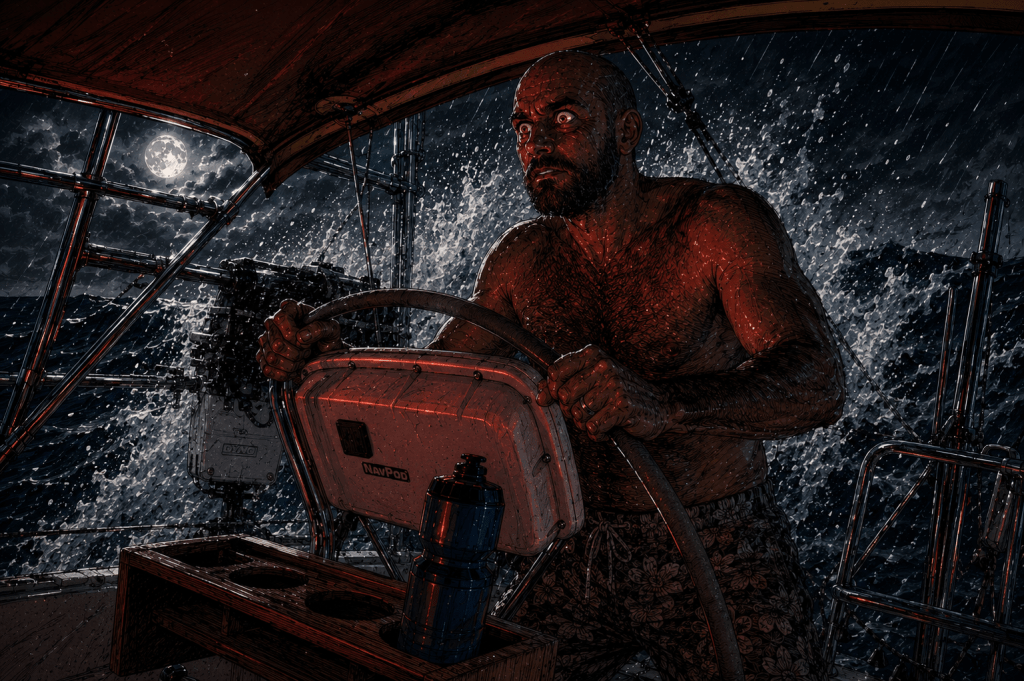
Forever I will remember the vision of Jesse white knuckle gripping the helm, the hammering of the motor near full throttle, and the red glow of the night vision electronics on his face. The whites of his eyes gleaming in the moonlight as the boat slammed into wave after wave. The rest of us went below for some “rest,” and I’d poke my head out every once in awhile to check on him and he’d be sitting there at the helm, white knuckling the wheel, eyes still wide – and he’d refuse to give the helm up to me. He didn’t let me take over until we were a few hours out of Cabo.
I do not consider this saga a part of the passage. We woke up the next morning, re-rigged the furler (it wasn’t broken), and went into the harbor to refill diesel. Passages start at your last port, and Cabo was clearly our last port. If you’re interested in the crew’s perspective on this matter, please see the comments section, where I am sure they will be opining shortly.
Total Nautical Miles Sailed: 3,088 nms. As the crow flies, it’s 2,614 nms from Cabo to Nuku Hiva, so we sailed an additional 474 nms on our route to find better winds and currents.
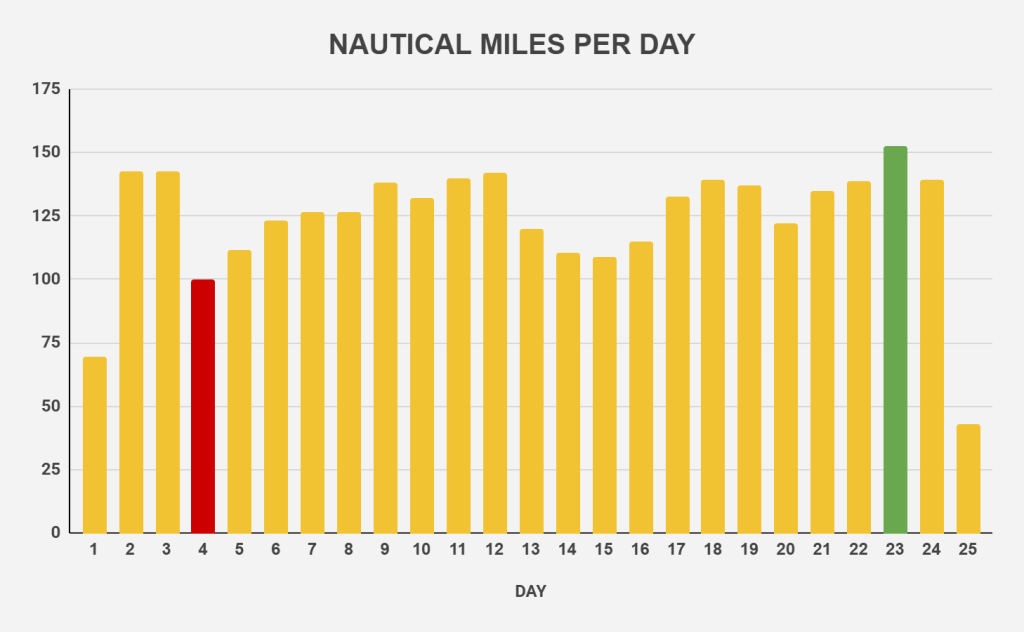
Longest 24-Hour Run: 152 nms on day 23.
Slowest 24-Hour Run: 100 nms on Day 4.
Strongest Wind: ~25kts in our very first squall.
Lightest Wind: 0kts, negative kts? Can wind go negative? It felt negative.
Squalls Encountered: Lost count. We were in the ITCZ for an eternity.
Fuel Consumed: 70 gallons. We carry 243 gallons on board, with 218 in two internal tanks and 25 gallons in jerry cans on the deck. Ultimately we only burned 29% of our fuel. This was across 115 hours of motoring, sadly some of which were due to needing the charge the batteries after the MPPT BBQ. The total trip was 576 hours, so we had the motor on for 20% of the total time.
Gallons of Water Consumed: 287 gallons. This equates to 12 gallons a day or 3 gallons a day per crew member. We carry 180 gallons across two internal tanks and another 10 gallons in jerry cans. We started the trip with tanks topped up, and arrived with tanks about half full.
Gallons of Water Made: 197 gallons. Running the desalinator is a battery draw, so as we closed in on our destination, we stopped making water because we knew we had enough to make it to land.
Onions Packed: 30
Onions Consumed: 24
Breakages: 8
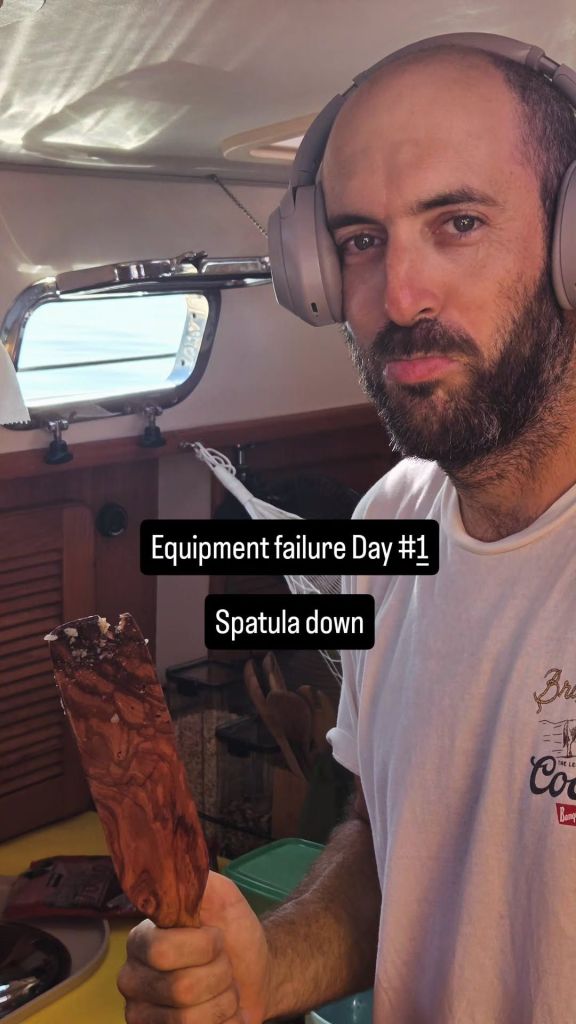
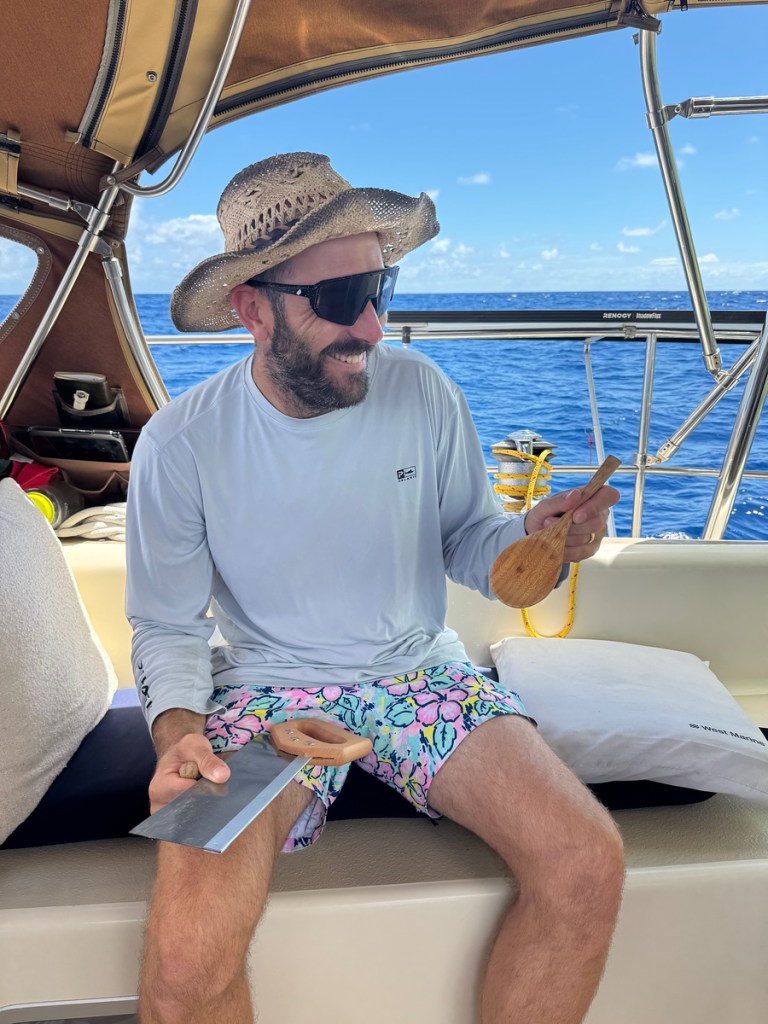
- Cooking Utensils: 2. My favorite spatula was the first breakage of the trip. A second bamboo serving spoon handle was sacrificed for the jury rig of the whisker pole, aka the birth of Mr. Spoonman.
- Furler: 1 But wait, didn’t I say the furler broke before the passage? Yes, it did. But we also pulled the line out of the drum a second time during a squall in the middle of the passage. Thankfully we had the recent practice of re-rigging it in Cabo, so while we had to do it on the high seas this time, with lots of swell, we knew exactly what had to be done. I was the tool monkey, with a backpack strapped to my front side, clinging onto the stanchions, handing Jesse one tool, one screw, one irreplaceable plastic component of the furling drum at a time. He’d hand them back to me one at a time, and I’d open the backpack, put it in, and zip it shut. We were experiencing 15 feet of vertical acceleration with each wave, and the special moments were when the whole bow submerged as we clung onto it, dunking us into the Pacific, just as we were trying to get the angle of the screw exactly right for reassembling the drum without cross threading it.
- MPPTs: 2 Two out of three MPPTs cooked when the panels put out more watts than their rating as we neared the equator, exposing loose connections between the MPPTs and batteries. This took out 75% of our solar capacity, by far the most serious breakage of the passage. We were able to jury rig one of the melted MPPTs back into service to get back to 50% solar capacity. We’ve since met multiple boats who have had this exact same issue. We now check the MPPT wiring regularly for tightness.
- Spinnaker: 1 Not sure if detangling the spinnaker counts as a breakage, but things got so twisted up we had to spread out the spinnaker inside the cabin, which is a bit of a joke given the spinnaker is 60 feet tall and about as wide, and the cabin is about 3 feet wide. We also took the opportunity to patch a few small tears with nylon spinnaker tape and got her flying again in no time.
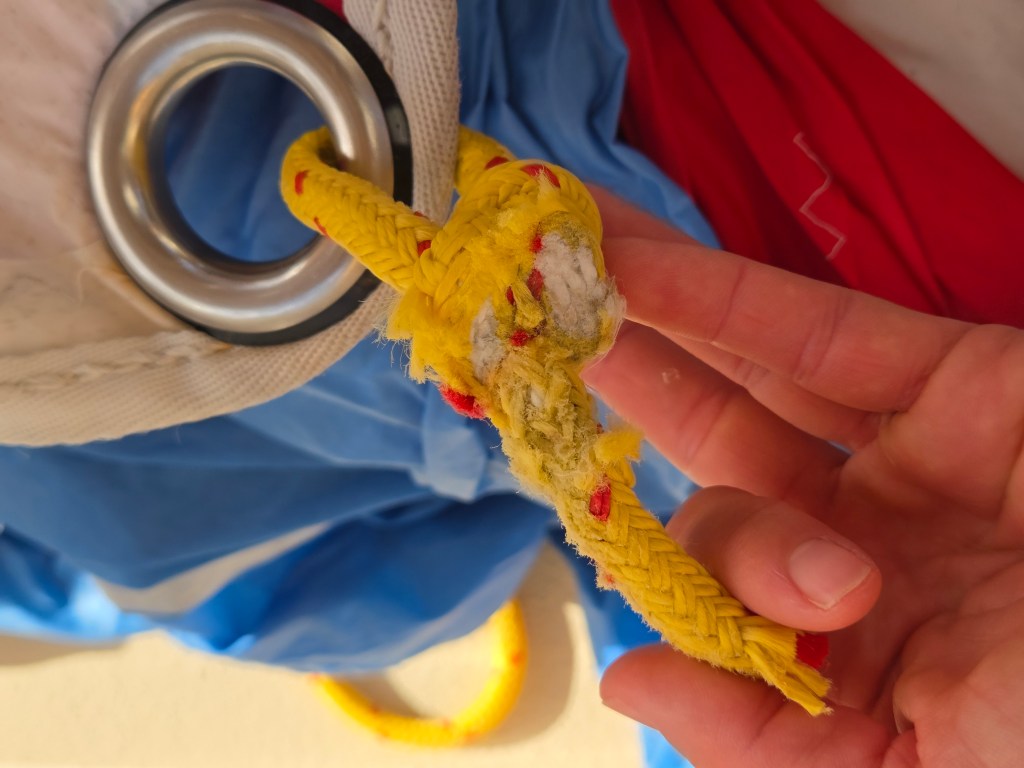
- Spinnaker Sheet: 1 It’s difficult to pick the #1 enemy of a long crossing, but chafe has to be up there. We’d done a lot of prepping to prevent chafe, and the spinnaker sheet is the one that got away from us. Thankfully it chafed right at the clew knot, so we chopped off a few inches from the end of the sheet and retied it on.
- Gasoline Jerry Can Lid: 1 Nothing brings you to attention from a restless stupor like the scent of gasoline fumes filling the cabin. One of the jerry can lids had cracked under the pressure of the expanding fumes from the heat of the equatorial sun. Thankfully we had spare lids on board and it was an easy fix. Our jerry cans even wear white Ts to protect them from the sun, but it was not enough. Everyone and everything was cracking from the heat.
% of Pacific Ocean Actually Crossed: 41%. If you were to consider the distance as the crow flies across the entire Pacific Ocean on our route, it would be from Baja Mexico to Australia. That distance is 6,300 nms. So we actually only sailed across 41% of the distance we have to go (you’re welcome Charlie).


Leave a note in the logbook