Sleeping was an idea – a concept we strived for but never fully realized. Each bunk had it’s own detraction. The aft cabin had the water heater under it which filled with hot water every time the engine was run, slowly cooking the unlucky crew attempting to sleep above. The starboard sette was in the middle of the cabin and so the sleeper was made aware of the moves of all crew at all times. And it’s only 5′ 8″ tall, so nobody but me could stretch out on it. The port sette is even shorter, but the real detraction is the heat – little ventilation between the velure cushions and the unbreathable silver-heat-reflective lee cloth made it a sweat box we coined the Dengue Corner. The front cabin, a queen size pullman berth – breezy, long and wide, and subject to violent g-forces in all directions from the boat movement that only Sarah and Dirk could “sleep” through.
We started out the trip with everyone staking out a single bunk – I was in the forward g-force berth. Jesse the starboard sette hallway. Dirk had Dengue Corner. Sarah the hotdog roller aft bunk. At some point in this journey, Sarah realized that Jesse and I had pretty much not slept at all. At the time, I thought she was a regular Sherlock Holmes to figure this out, but in retrospect after a week or two without any solid sleep I can only imagine Jesse and I were functioning about as well as – well – two people anthropomorphizing pieces of kitchen utensils. And we were supposed to finish sailing this boat across the ocean we were currently in the middle of.
So Sarah proposed we hot-swap bunks. We change the night shift schedule! And we did. Rotating through the miserable bunks was somehow better than fighting the same demon all night long. Dengue Corner was taken out of the rotation altogether. We started getting some real sleep. Three hours on the hotdog roller, three hours at the helm praying every time you turn on the radar there wasn’t a new squall menacing you, and then six hours in the g-force bunk – sounds like a solid night’s rest to me.
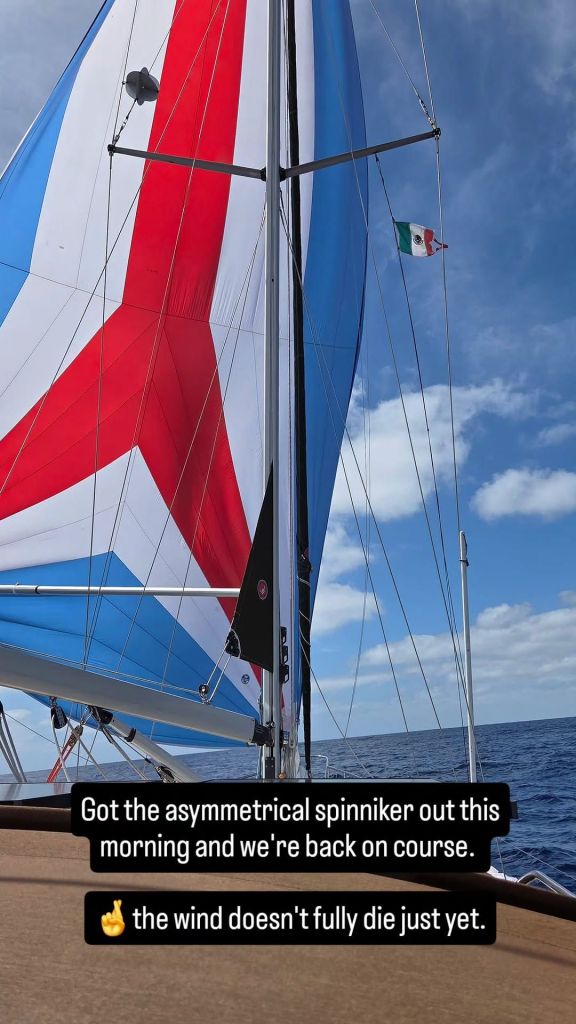
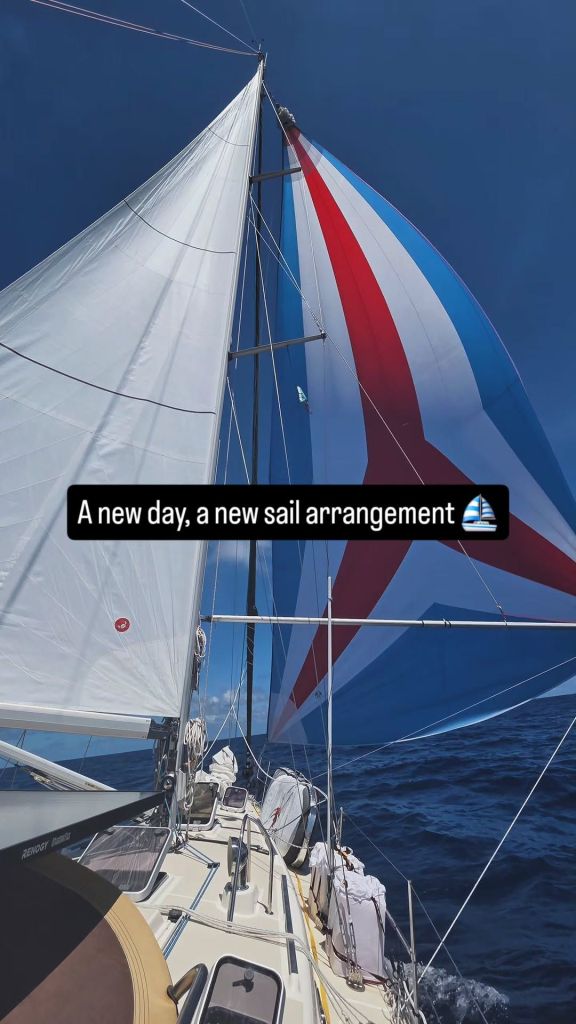
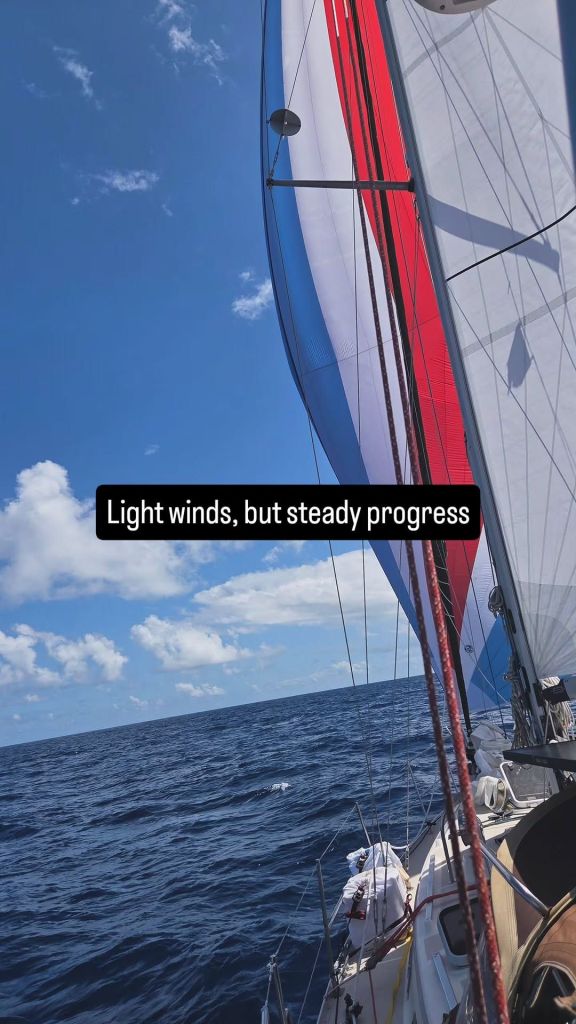
In addition to the sleep, our constant flying of the asymmetrical spinnaker helped us regain our sanity. With the big billowy light sail up, it pulled the boat forward through the water with enough pressure to dampen the rolling. The boat moved, although slowly, through the water, day after day.
It’s a spinnaker, so there is always an issue with putting it up or taking it down. The dousing sock cord jams. The sail twists. The wind gusts and the boat is moments from broaching. When something goes wrong with the spinnaker, it goes from pleasant to nightmarish in a second. Jesse is instantly buried on the foredeck in yards and yards of nylon that could snap back into a full sail at any moment. The crew is learning new swear words as we watch on, and then using these new swear words as we desperately try to steer the boat and trim the sheet so as not to refill the sail, which would result in these new swear words being used at us from the foredeck. You say a small prayer every time the spinnaker goes up. And you say a really big prayer every time the spinnaker needs to come down.
But we were committed to this fickle sail. Committed enough to fly it overnight, something I never thought I’d do. I actually relaxed while the spinnaker was up – something else I never thought would happen. But after enough exposure therapy to it’s various abuses, I learned to live with knowing any moment something horrible was likely to happen with the sail, mainly because Jesse was able to deal with it every time something did go wrong. And for us, it was a choice between the constant abuse of the ocean tirelessly tossing the boat to and fro or the intermittent abuse of the spinnaker tangling itself.
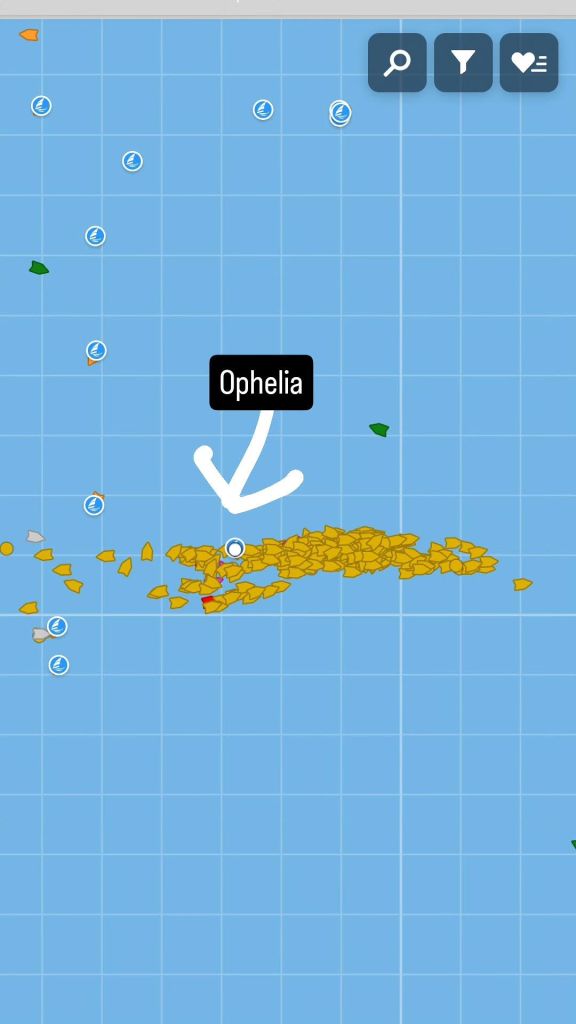
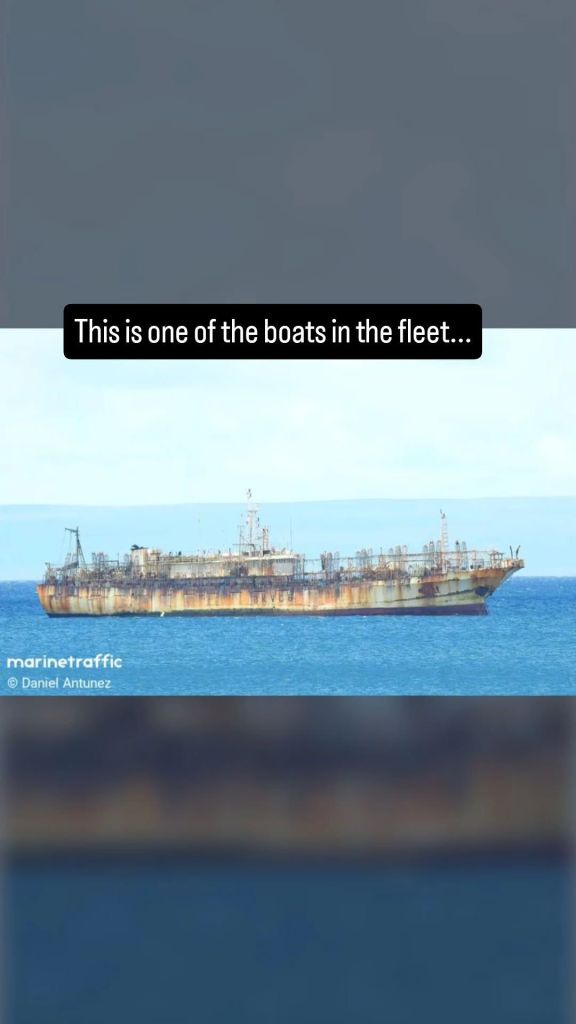
And if the spinnaker wasn’t enough excitement to be had, there was a looming long distance offshore Chinese fishing fleet of hundreds of boats spanning 400 nms in the middle of our path. The other boats crossing the Pacific ahead of us had all altered course to go West of the fleet, but we were keeping alive a dream of landfall in Gambier which required us to stay further East. We watched the fleet on AIS for days – openings in the line of boats would appear, expand, and then contract again. We researched the fleets online, learning the crews were indentured laborers stuck at sea for year after year without ever making landfall. Our weather routers sent us details and screen shots of their experience crossing one of these fleets years ago. We looked up the MMSI numbers from individual boats in the fleet and were alarmed by the condition of the vessels. We found a YouTube video of a catamaran that sailed through the same fleet a year ago. As we drew close to the go/no-go decision point of cutting through or going around, a gap opened – and we took it.
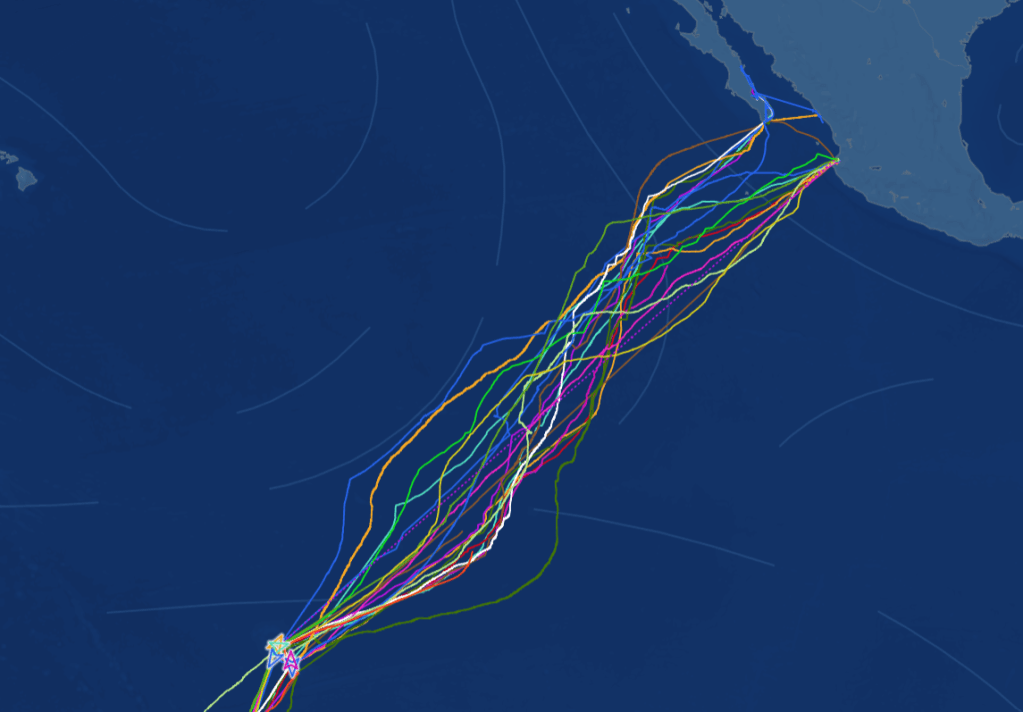
There was no wind to speak of, so it was engine on, hammering dead South to get across as quickly as possible. We were guided by the compass, and had to force ourselves to look away from the train wreck of a GPS track we were laying down. There was a wicked 3kt current pulling us back East, towards Panama, that spanned an unbelievable number of miles. When you’re going 4.5kts, a 3kt current on your beam sweeps you sideways nearly as fast as you are making progress forwards. But there was nothing to be done about it – to shift bearing and offset the sideways drift would have only slowed our progress making it across the current. So the best course of action was to look away from the chart plotter. Except, of course, for obsessively watching it to monitor the AIS locations of the fishing boats.
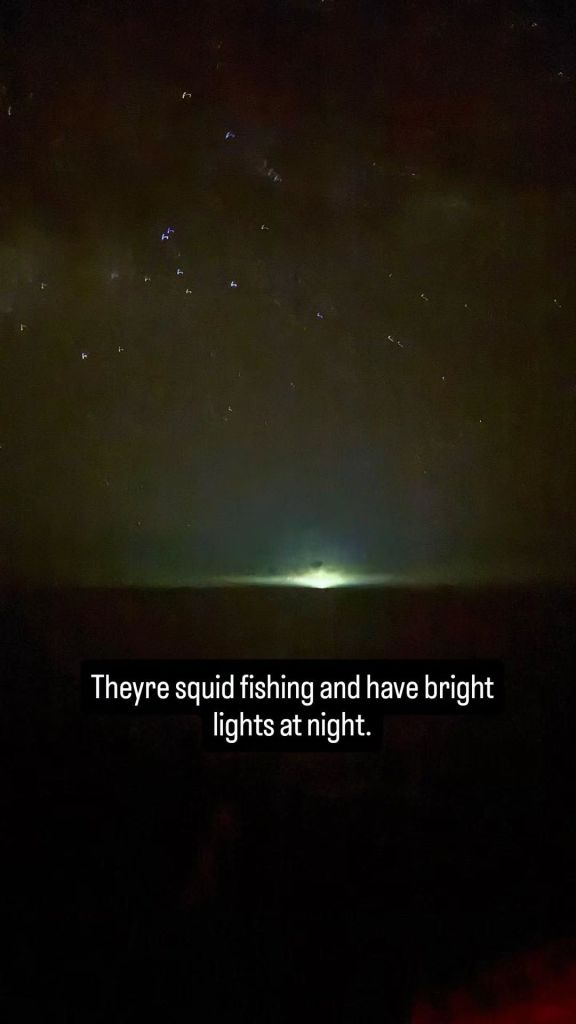
And the obsessive monitoring was required – the fishing boats turned their AIS on and off, on and off. While passing off duties to the next watch keeper the critical information to share was where a boat disappeared off the AIS last, and how long ago the boats on the AIS had popped up. Crossing this fleet took over a day. At night when I emerged into the cockpit for my shift, we were surrounded by glowing orbs on the horizon 360 degrees around us – like we were on a far off planet with many moons rising at once. Each boat was shining powerful lights down into the water to draw up the deep sea creatures, namely squid, for capture. We never got close enough to see the boats with our naked eyes. At night, we only saw the direct light beams of a handful of boats, and the rest we only saw their ominous glowing just under the horizon. We debated if this was the ships avoiding us, or just luck. I think a combination of both.
We had attempted to hail what looked like the commanding ship before crossing the fleet – there was a response, but in Chinese over garbled VHF reception. Our phone’s translation of it was nonsense. We tried again. Another garbled response with meaningless translation. But hey – it was confirmation they were aware of our presence. Hopefully they weren’t telling us to fuck off and go around like everyone else.
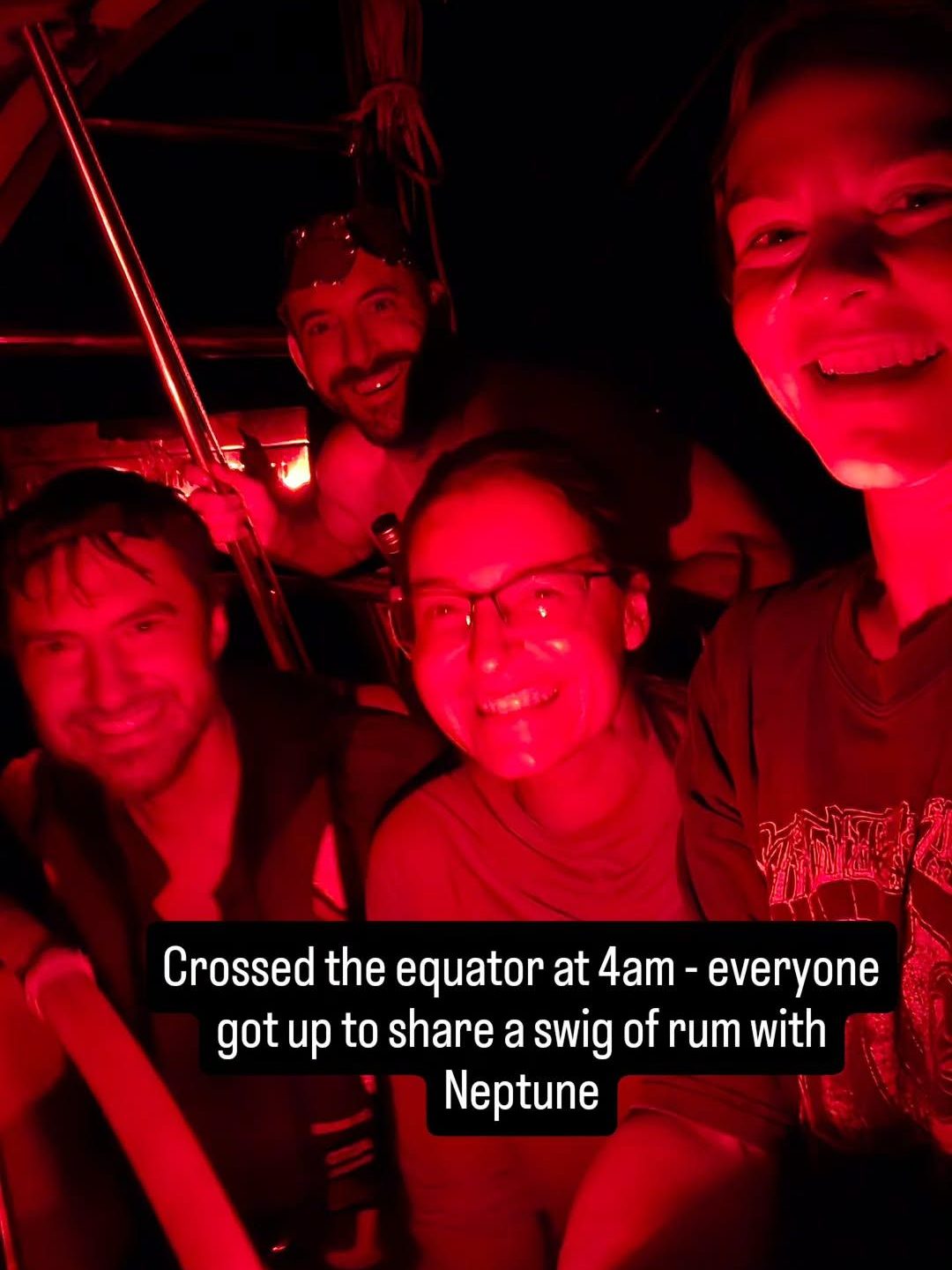
Towards the end of crossing this fleet, we also crossed the equator – a major sailing achievement for our boat of Pollywogs, soon to be Shellbacks. Typically, the existing Shellbacks on board haze the Pollywogs, making them do all sorts of nonsense like jumping in the water and swimming around the boat or dressing up in ridiculous costumes. Since we were an entire boat of Pollywogs with nobody onboard to haze us, we settled for passing around a bottle of rum while wearing tinfoil hats and singing along to “This is the final count down” – the sound track selected by Dirk and set to play before he woke the rest of us from our bunks for our 4am crossing of the equator.
Surrounding all this excitement – crossing fishing fleets and crossing the equator – the wind was still light, dead, unpredictable. Our progress slow. But this was our world now, and we settled into what had become of our existence.
We (ie, Dirk) spent many many hours identifying sea birds, quiet ineffectively. When a piece of garbage floating by was spotted, the whole crew would scramble to the side of the boat to look at it – an unmoored fish luring FAD raft with electronics in a dome housing being the most exciting (mainly because we didn’t know what it was at the time and our imaginations went wild) and the various mix of plastic bottles being the least exciting. One night, the stars came out – we’d of course seen the stars many nights, but this night – with no moon and no clouds – the stars cast shadows across the boat. Part of the night sky was new stars I’d never seen in the Northern hemisphere. I didn’t know how well I knew the night sky until seeing this new slice of it only visible in the Southern hemisphere. There was a patch that stunned me, mesmerized me – a grouping of stars I’d never seen before. A constellation burning away for millenniums, all this time hidden from my eyes on the other side of the planet. I couldn’t look away. The whole crew sat up in the cockpit, staring into the night sky, past our watches and past our bedtimes.
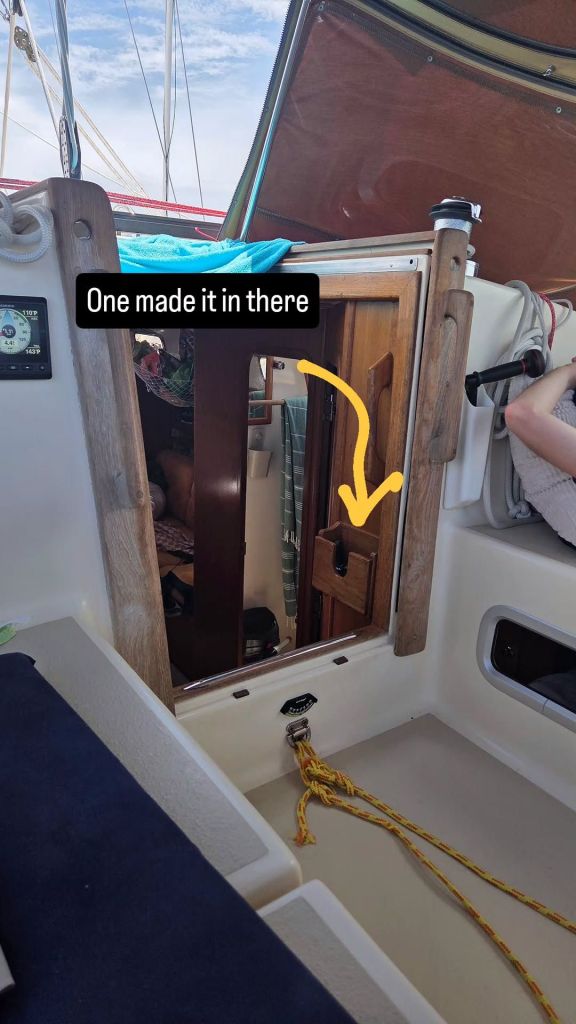
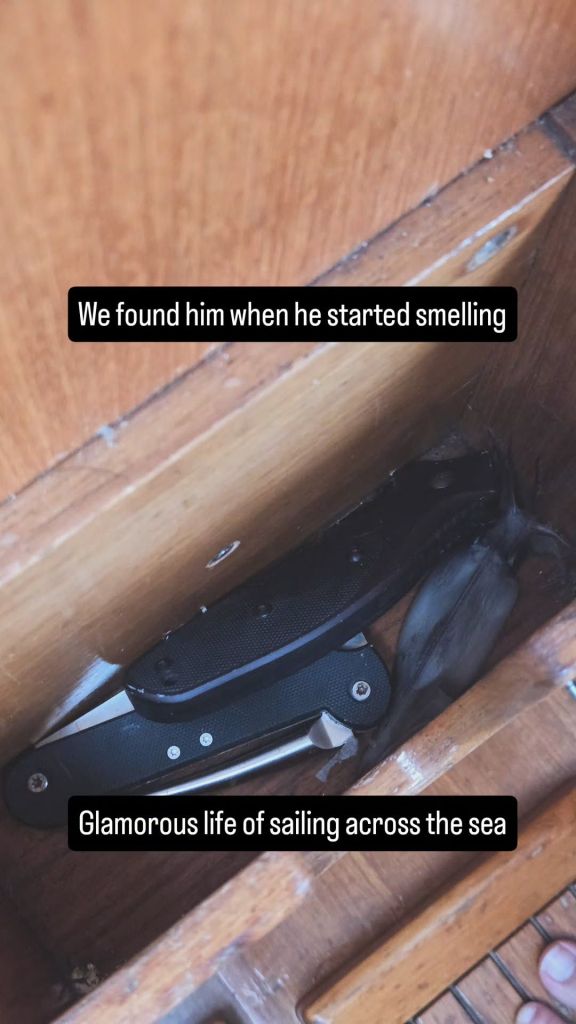
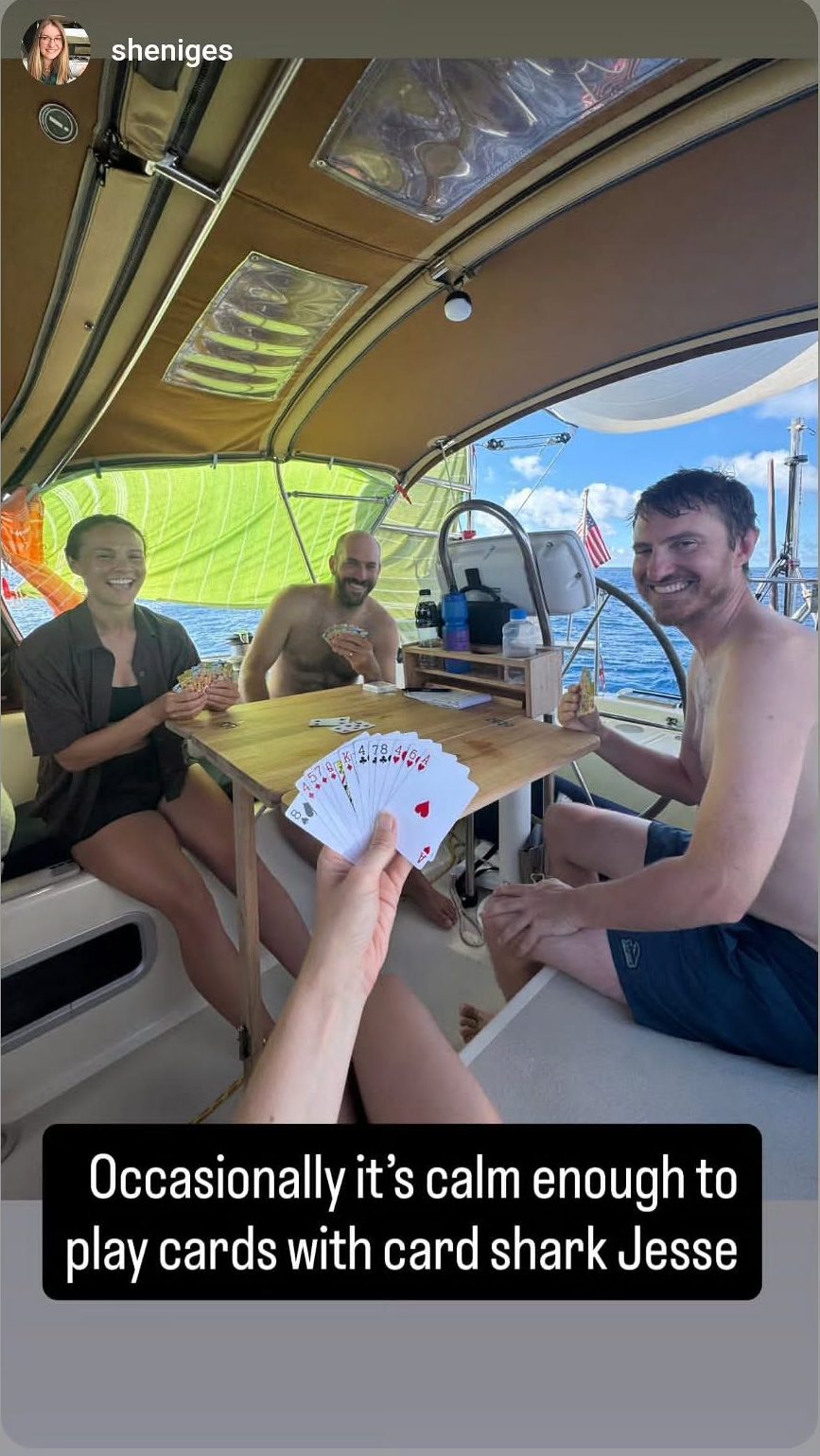
We discovered the existence of jumping squid when one made it through the companion way and into the headlamp cubby, an improbable landing pad only 3″ by 7″. He was discovered after he started smelling pungent a few days later – everyone’s headlamps scented like shrimp chips for the next week. A real treat when you needed a headlamp at 2am because something made a weird noise and investigation was required. We napped anywhere we could lay our heads down with a breeze. The premium snack on board became frozen pineapple, consumed chunk after chunk until our mouths were raw from the acid. We started playing hearts in the afternoons, with varying levels of commitment to “winning” across the crew. Sarah and I often handing out the jack of hearts to the leader or the queen of spades to the player in the rear, much to the delight of the other crew and the chagrin of Jesse who was futilely attempting to employ multi-round, multi-hand strategy to this card game on the high seas. Chapters of books were read, level after level of tablet games completed.
And then it all changed. When an eternity ends, it feels abrupt. The anemometer picked up. The wind direction held consistent. We were pointed towards the Marquesas. The sails were full. Swell was not coming through the port holes. We started pulling shots of espresso for our morning coffees. And so we entered into the final happy chapter of our journey.
 Ophelia Offshore
Leave a note in the logbook